

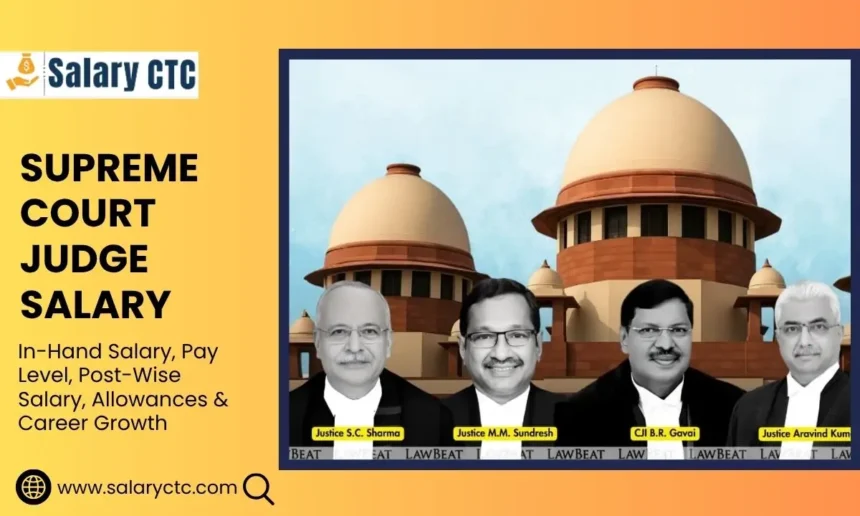
The Supreme Court of India is the highest judicial body in India. The position of being a Supreme Court Judge in India is one of the most prestigious positions in the Indian Constitutional set-up. Supreme Court Judges interpret the Constitution of India, protect the fundamental rights of citizens, settle disputes between states and the Union, and deliver important judgments for the benefit of the nation. The most frequently asked question regarding the Supreme Court is: “What is Supreme Court Judge Salary?”
Since their duties are extremely crucial, the Supreme Court Judges have an attractive salary package along with various facilities offered by the government. Their salary structure is determined by the Parliament of India, and at regular intervals, is revised through legislation.
This comprehensive guide covers everything related to Supreme Court Judge Salary, which includes basic salary, in-hand salary, facilities, appointments, duties, etc.
Who Is a Supreme Court Judge?
An appointment of Supreme Court Judge is made to the Supreme Court of India to hear cases relating to constitutionality issues, civil appeals, criminal appeals, public interest litigation, election matters, and other such nationally important cases.
The composition of the Supreme Court is as follows:
- Chief Justice of India (CJI)
- Other Supreme Court Judges
Each and every judge enjoys equal judicial power in deciding cases, but administrative powers rest with the Chief Justice.
Salary of Supreme Court Judge (Updated)
Supreme Court Judge’s salary is regulated by the Supreme Court Judges (Salaries and Conditions of Service) Act from time to time.
Monthly Salary of Supreme Court Judge: ₹2,50,000
This is the monthly salary of a Supreme Court Judge (excluding the Chief Justice of India).
Chief Justice of India Salary
The Chief Justice of India (CJI) receives a higher salary.
Basic Salary of the Chief Justice of India: ₹2,80,000 per month
Other facilities provided to the CJI by the government in an official capacity.
Salary of Supreme Court Judge In-Hand
As many facilities are provided to the judges in hand by the government, the deductions of the judge in a month usually amount only to income tax.
Approximate In-Hand Salary
₹2.20 lakh – ₹2.45 lakh per month
The actual amount will be dependent on one’s taxable income and the deductions.
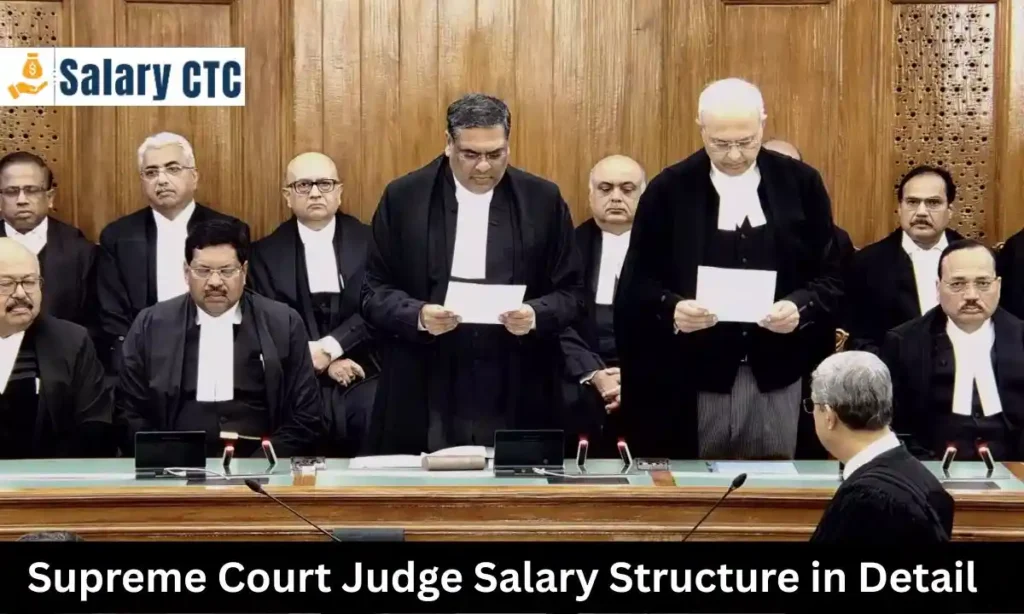
Supreme Court Judge Salary Structure
| Salary Component | Approximate Amount |
|---|---|
| Basic Salary | ₹2,50,000 |
| Official Allowances | As per government rules |
| Government Facilities | Provided separately |
| Official Residence | Provided |
Unlike most civil servants, some facilities are received directly instead of monetary allowances.
Facilities Provided to Supreme Court Judges
Along with salary, Supreme Court judges also receive various official facilities.
Major Benefits
- Official government residence
- Domestic staff support (as per rules)
- Chauffeur-driven official vehicle
- Fuel and maintenance facilities
- Medical facilities
- Telephone and communication facilities
- Security arrangements
- Official travel facilities
- Hospitality facilities for official duties
They greatly enhance the worth of the whole remuneration package.
Medical Benefits
The Supreme Court judges get full healthcare services.
These usually include:
- Medical assistance to the judge
- Facilities of medical assistance to eligible family members
- Reimbursement of approved medical treatments
- Services of government-approved hospitals
Travel Benefits
Judges have right to travel on account of their judicial and administrative functions.
Benefits may include:
- Official air travel
- Rail travel
- Staff assistance during official tours
- Transport arrangements
Pension Benefits
After retirement, the Supreme Court judges become eligible for pension and other retirement allowances as per law.
Benefits may include:
- Monthly pension
- Family pension (subject to rules)
- Medical benefits
- Retirement gratuity
- Other statutory post-retirement entitlements
How Is a Supreme Court Judge Appointed?
The appointment of Supreme Court judges is done by the President of India as per constitutional provisions.
A person usually becomes eligible for appointment as Supreme Court Judge if he/she:
- Has been a judge of the High Court for a sufficient period, or
- Is an advocate of a High Court for a certain constitutional period, or
- Is a distinguished jurist (under the Constitution).
The appointments are made through the constitutionally mandated procedure.
Qualifications Required
One needs to fulfill the criteria of qualifications that have been laid down in the Constitution of India in order to be appointed as a Supreme Court Judge.
Typical qualifications include:
- Indian citizenship
- Extensive judicial or legal experience
- High professional reputation
- Constitutional eligibility requirements
Retirement Age
The retirement age of a Supreme Court Judge is:
65 years
Judges can take up other tasks upon retirement, provided that this is allowed by law.
Job Profile of a Supreme Court Judge
There are many constitutional and judicial duties performed by a Supreme Court Judge.
Major Responsibilities
- Hearing constitutional cases
- Deciding civil appeals
- Deciding criminal appeals
- Protecting fundamental rights
- Interpreting constitutional provisions
- Reviewing laws
- Resolving disputes between governments
- Delivering landmark judgments
- Supervising judicial administration in certain matters
Their decisions frequently become precedents.
Working Environment
Supreme Court Judges operate in one of the intellectually challenging professions in the country.
Typical work includes:
- Court hearings
- Legal research
- Judgment writing
- Constitutional interpretation
- Administrative meetings
- Reviewing petitions
- Bench conferences
It requires neutrality, integrity, and profound legal knowledge.
Career Path to Become a Supreme Court Judge
Most Supreme Court Judges enter into this institution after years of outstanding performance in the legal profession.
Typical Career Progression
Law Graduate → Advocate → Senior Advocate / Judicial Service → High Court Judge → Chief Justice of High Court (in many cases) → Supreme Court Judge
This journey often spans several decades.
Salary Comparison
| Position | Monthly Salary |
|---|---|
| High Court Judge | ₹2,25,000 |
| Supreme Court Judge | ₹2,50,000 |
| Chief Justice of India | ₹2,80,000 |
Besides salary, there are other privileges that come with the post.
Why Is This Position Prestigious?
To be appointed as a Supreme Court Judge is considered as one of the highest honors in the Indian legal fraternity due to:
Main Advantages
- Authority conferred by Constitution
- Highest judicial post other than that of Chief Justice
- Lavish salary
- Government housing
- Facilities for medical care
- Benefits under pension scheme
- National recognition
- The opportunity to interpret constitutional laws
- Challenges of the Profession
Though it carries great prestige, it entails enormous responsibilities as well.
Main Challenges
- Large judicial burden
- Complicated constitutional issues
- Public glare
- Time bound cases
- High ethical standards
- Taking landmark decisions
It is necessary for judges to always be impartial and independent.
Scope in Future
Even after retirement from the service at the age of 65 years, Supreme Court judges can still play an active role in public affairs in various ways.
Frequently Asked Questions (FAQ)
A Judge of the Supreme Court receives a basic salary of ₹2,50,000 per month, along with official facilities and benefits.
The Chief Justice of India receives a basic salary of ₹2,80,000 per month.
Yes. Eligible judges are provided with official government accommodation and other associated facilities.
The retirement age is 65 years.
Yes. Eligible retired judges receive pension and retirement benefits in accordance with applicable laws and service conditions.
Conclusion
The Supreme Court Judge Salary reflects the importance and dignity of one of India’s highest constitutional offices. With a basic salary of ₹2,50,000 per month, official accommodation, medical care, transportation, security, pension, and other government facilities, the position offers a comprehensive compensation package that matches its immense responsibilities.
However, the true significance of becoming a Supreme Court Judge lies beyond the salary. Judges are entrusted with safeguarding the Constitution, protecting citizens’ rights, and ensuring justice for the nation. For legal professionals aspiring to reach the pinnacle of the judiciary, serving as a Judge of the Supreme Court of India represents the highest level of professional achievement, responsibility, and public service.
Also, Read: Medical Officer Salary | Navy Salary Per Month | PEO Salary in Odisha | Jharkhand Home Guard Salary | Indian Forest Service Salary | Seep Pahuja Salary | SSC CHSL Jobs List and Salary | Cloud Engineer Salary | Branch Post Master Salary | CM Salary in India | Preventive Officer Salary | AFCAT Salary | PCS Salary | DMLT Salary