

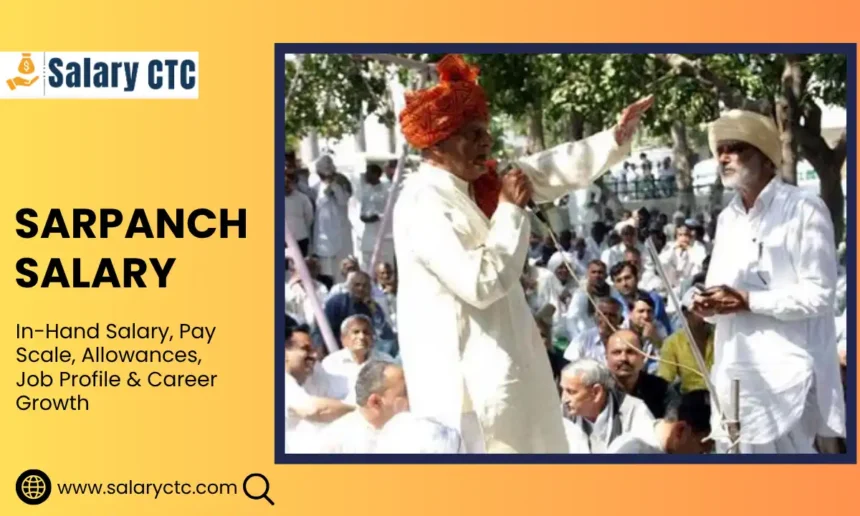
The post of Sarpanch is one of the most important elected positions in India’s rural governance system. A Sarpanch is the head of a Gram Panchayat and represents the village at the grassroots level. The person holding this post is responsible for village development, public welfare, sanitation, water supply, roads, Gram Sabha meetings, government scheme implementation, and coordination with government officials.Many people search for Sarpanch salary because the post carries public respect, leadership authority, political importance, and administrative responsibility.
However, it is important to understand that a Sarpanch does not receive a regular government employee salary like a clerk, teacher, police constable, or officer. The money paid to a Sarpanch is generally called honorarium, not salary. The amount differs from state to state because Panchayati Raj matters are largely governed by state rules.
In some states, the monthly honorarium may be around ₹3,000 to ₹5,000, while in some states it can be ₹6,500, ₹7,500, ₹10,000 or more, depending on government policy.
This detailed article explains the Sarpanch Salary, including monthly honorarium, state-wise salary, annual income, powers, duties, election process, benefits, challenges, and career scope.
What Is a Sarpanch?
Sarpanch is the elected head of Gram Panchayat. Gram Panchayat is the village-level local self-government body in the Panchayati Raj system.
The Sarpanch functions as the chief representative of the village and head of the Panchayat regarding developmental and administrative activities.
In different states, the Sarpanch may also be called:
- Gram Pradhan
- Panchayat President
- Village Head
- Gram Panchayat Pradhan
- Panchayat Sarpanch
- Village Panchayat Head
The name may vary from one state to another; however, the post holds a village governance connection.
Sarpanch Salary 2026 Overview
| Particular | Details |
|---|---|
| Post Name | Sarpanch |
| Also Known As | Gram Pradhan / Village Head / Panchayat President |
| Post Type | Elected Representative |
| Level | Gram Panchayat / Village Level |
| Payment Type | Monthly Honorarium |
| Average Monthly Honorarium | ₹3,000 – ₹10,000+ approx. |
| Regular Government Salary | No |
| Pay Scale | Not applicable |
| DA / HRA | Usually not applicable |
| Election Term | Generally 5 years |
| Main Work | Village development and Panchayat administration |
| Career Scope | Local politics, Panchayat leadership, higher public roles |
Sarpanch Salary Per Month
The monthly pay of the Sarpanch is provided as honorarium.
Average Monthly Honorarium
₹3,000 – ₹10,000+ Per Month
The exact amount depends on:
- State government policy
- Panchayat Raj rules
- Population of village
- Panchayat category
- Latest government revision
- Budget approval
- Payment release status
There is no single fixed Sarpanch salary for all India.
Is Sarpanch Salary or Honorarium?
Technically, Sarpanch payment is called honorarium, not salary.
| Point | Salary | Honorarium |
|---|---|---|
| Given To | Employees | Elected representatives/service roles |
| Pay Scale | Usually fixed under pay matrix | Fixed amount decided by government |
| DA/HRA | Often applicable | Usually not applicable |
| Pension | May apply in regular jobs | Usually not like regular employees |
| Sarpanch Payment | Not regular salary | Monthly honorarium |
Hence, whenever the term “Sarpanch salary” is used, it means Sarpanch monthly honorarium.
Why Sarpanch Does Not Get Regular Salary
The Sarpanch is not appointed as any government official. Rather, the individual gets elected by villagers through the vote for a certain period of time.
Main Reasons
- Sarpanch is an elected public representative.
- The post is not a permanent government job.
- It does not follow a pay matrix.
- There is no grade pay.
- DA and HRA are usually not provided.
- Panchayat funds are for public development, not personal income.
- State governments decide honorarium separately.
This is why Sarpanch income is much lower than regular government employee salary.
State-Wise Sarpanch Salary
Sarpanch salary differs from state to state. Below is an approximate table for general understanding.
| State | Approximate Monthly Honorarium |
|---|---|
| Uttar Pradesh | ₹3,500 – ₹5,000 approx. |
| Telangana | ₹6,500 approx. |
| Himachal Pradesh | ₹7,500 approx. |
| Rajasthan | ₹4,000 – ₹6,000 approx. |
| Madhya Pradesh | ₹4,000 – ₹6,000 approx. |
| Bihar | ₹4,000 – ₹6,000 approx. |
| Haryana | ₹5,000 – ₹8,000 approx. |
| Punjab | ₹5,000 – ₹10,000 approx. |
| Maharashtra | Varies by Panchayat category |
| Gujarat | ₹4,000 – ₹7,000 approx. |
| Karnataka | Varies by local body rules |
| Andhra Pradesh | Varies by policy |
| West Bengal | Varies by Panchayat rules |
Note: These figures are approximate. The final amount can change after state government revisions.
Sarpanch Annual Income
Sarpanch salary varies from state to state. The below mentioned table shows the approximate figure for the reference purpose.
| Monthly Honorarium | Annual Honorarium |
|---|---|
| ₹3,000 | ₹36,000 |
| ₹5,000 | ₹60,000 |
| ₹6,500 | ₹78,000 |
| ₹7,500 | ₹90,000 |
| ₹10,000 | ₹1,20,000 |
| ₹15,000 | ₹1,80,000 |
The above figure is just the official honorarium; there is no consideration of personal income of the Sarpanch from agriculture, profession, business, etc.
Sarpanch In-Hand Salary
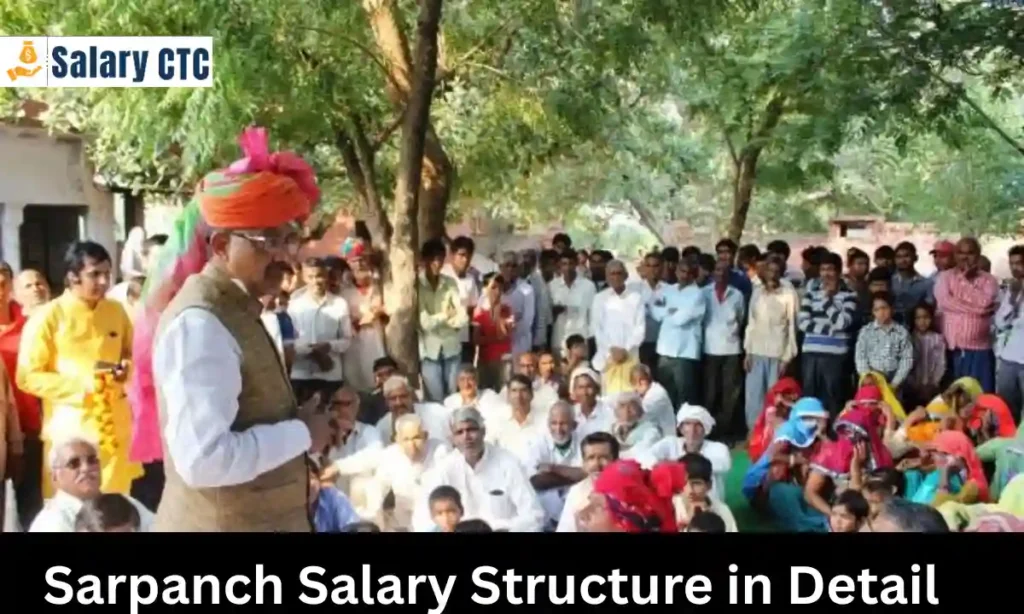
As the payment of Sarpanch is based on the honorarium, in-hand figure is always near to the official figure of honorarium.
Approximate In-Hand Amount
₹3,000 – ₹10,000+ Per Month
However, actual payment may be affected by:
- Government fund release
- District-level processing
- Bank transfer delays
- Pending honorarium bills
- Panchayat department approval
- State-level budget process
In some cases, honorarium may be delayed and released later.
Does Sarpanch Get DA, HRA or Grade Pay?
No, a Sarpanch generally does not receive government employee-style allowances.
| Allowance / Benefit | Applicable to Sarpanch? |
|---|---|
| Dearness Allowance | Usually No |
| House Rent Allowance | Usually No |
| Transport Allowance | Usually No |
| Grade Pay | No |
| Pay Matrix | No |
| Regular Pension | Usually No |
| Annual Increment | Not like regular employees |
The post is political and representative in nature, not employment-based.
Can Sarpanch Use Panchayat Funds as Salary?
No. Panchayat funds are public funds and cannot be used as personal income.
Panchayat Funds Are Used For
- Village roads
- Drainage
- Street lights
- Drinking water
- Public toilets
- Sanitation work
- Panchayat Bhawan
- Community halls
- Anganwadi support
- Public welfare schemes
- Village development projects
The use of Panchayat money for any personal purposes is illegal and may lead to investigation, recovery, removal, disqualification, or any other action.
Sarpanch Salary in Telangana
In Telangana, the Sarpanch receives a monthly honorarium.
Approximate Monthly Honorarium
₹6,500 Per Month
Annual Honorarium
₹78,000 Per Year
Though Telangana Sarpanch honorarium is better than some states, yet it is not the same as the official salary.
Sarpanch Salary in Himachal Pradesh
Himachal Pradesh Gram Panchayat Pradhan honorarium is among the best revised figures.
Approximate Monthly Honorarium
- ₹7,500 Per Month
Annual Honorarium
- ₹90,000 Per Year
This amount may change after future revisions by the state government.
Sarpanch Salary in Uttar Pradesh
In Uttar Pradesh, the village head is commonly called Gram Pradhan.
Approximate Monthly Honorarium
- ₹3,500 – ₹5,000 Per Month
The exact amount may depend on the latest state policy and local rules.
Sarpanch Salary in Rajasthan
In Rajasthan, the Sarpanch is the elected head of the Gram Panchayat.
Approximate Monthly Honorarium
- ₹4,000 – ₹6,000 Per Month
The figure may change depending upon the state government revision and the Panchayati Raj rules.
Sarpanch Salary in Madhya Pradesh
In Madhya Pradesh, Sarpanch honorarium is also state-regulated.
Approximate Monthly Honorarium
- ₹4,000 – ₹6,000 Per Month
The Sarpanch holds the major responsibility of rural development and implementation of schemes.
Sarpanch Salary in Haryana
The honorarium of Sarpanch in Haryana may change as per the state policy and revision.
Approximate Monthly Honorarium
- ₹5,000 – ₹8,000 Per Month
The Sarpanch works closely with Gram Sachiv and other Panchayat-level officials.
Sarpanch Salary in Punjab
Punjab Sarpanch honorarium can vary according to state decisions and revisions.
Approximate Monthly Honorarium
- ₹5,000 – ₹10,000 Per Month
The exact amount should be checked from the latest official Panchayati Raj update.
Sarpanch Salary vs Panchayat Secretary Salary
Many people confuse Sarpanch and Panchayat Secretary, but both are different.
| Point | Sarpanch | Panchayat Secretary |
|---|---|---|
| Selection | Elected by villagers | Appointed by government |
| Position Type | Public representative | Government employee |
| Payment | Honorarium | Regular salary |
| Pay Scale | No | Yes |
| DA/HRA | Usually no | Yes, as per rules |
| Main Work | Leadership and public representation | Records and administration |
| Tenure | Election-based | Service-based |
While the Sarpanch is the head of the Panchayat, the Panchayat secretary is the official who manages official work and documentations.
Sarpanch vs Gram Pradhan Salary
Sarpanch and Gram Pradhan are similar roles, but the term differs by state.
| Point | Sarpanch | Gram Pradhan |
|---|---|---|
| Common Usage | Telangana, Rajasthan, Haryana, Punjab, etc. | Uttar Pradesh, Uttarakhand, etc. |
| Role | Village head | Village head |
| Payment Type | Honorarium | Honorarium |
| Term | Usually 5 years | Usually 5 years |
| Salary | State-wise | State-wise |
Both are village-level elected representatives under the Panchayati Raj system.
Sarpanch vs MLA Salary
Though both Sarpanch and MLA are the elected officials, yet the level and salary of these posts vary widely.
| Point | Sarpanch | MLA |
|---|---|---|
| Area | Village / Gram Panchayat | Assembly constituency |
| Level | Local government | State legislature |
| Payment | Honorarium | Salary + allowances |
| Responsibility | Village development | Lawmaking and constituency work |
| Salary Amount | Much lower | Much higher |
| Political Scope | Grassroots | State level |
A Sarpanch can build political experience and later contest higher elections.
Main Duties of a Sarpanch
The Sarpanch has wide responsibilities at the village level.
Major Duties
- Conducting Gram Sabha meetings
- Leading Gram Panchayat meetings
- Monitoring development work
- Coordinating with Panchayat Secretary
- Helping implement government schemes
- Identifying eligible beneficiaries
- Supporting sanitation work
- Ensuring drinking water facilities
- Monitoring road and drain construction
- Supporting street light maintenance
- Representing villagers before officials
- Helping resolve local problems
- Supporting health camps
- Coordinating with schools and Anganwadi centres
- Encouraging public participation
The Sarpanch is the main voice of the village in local governance.
Role of Sarpanch in Village Development
Village development is the biggest responsibility of a Sarpanch.
Common Development Areas
| Development Area | Examples |
|---|---|
| Roads | Internal village roads and repair work |
| Drainage | Drain construction and cleaning |
| Water | Drinking water supply, handpump repair |
| Sanitation | Cleanliness drives and waste management |
| Lighting | Street light installation and maintenance |
| Welfare | Scheme awareness and beneficiary support |
| Education | Supporting schools and Anganwadi centres |
| Health | Supporting vaccination and health camps |
| Public Assets | Community halls and Panchayat buildings |
A good Sarpanch can bring visible improvements to a village.
Sarpanch and Gram Sabha
Gram Sabha is the general body of the voters of the village. It is one of the most important bodies in the local democracy.
Sarpanch Role in Gram Sabha
- Calling meetings
- Presenting development plans
- Listening to villagers’ problems
- Discussing Panchayat budget
- Taking public suggestions
- Reviewing completed works
- Sharing scheme information
- Encouraging transparency
A strong Gram Sabha makes the Panchayat more accountable.
Powers of Sarpanch
The Sarpanch holds some very crucial powers of local governance, which should always be utilized as per the legal rules and regulations.
Important Powers
- Presiding over Gram Panchayat meetings
- Signing selected Panchayat documents
- Supervising village development works
- Coordinating with government officials
- Helping prepare village development plans
- Supporting beneficiary selection
- Monitoring public services
- Representing village demands
- Working with Panchayat Secretary on official matters
A Sarpanch cannot misuse power or act against Panchayati Raj rules.
Financial Responsibilities of Sarpanch
The Sarpanch holds a significant role in financial accountability but does not hold the ownership of the Panchayat money.
Financial Duties Include
- Monitoring use of Panchayat funds
- Supporting budget preparation
- Ensuring approved works are completed
- Checking development project progress
- Supporting transparency
- Participating in financial decisions
- Coordinating with Panchayat Secretary
- Supporting audit and record work
Financial honesty is one of the most important qualities of a Sarpanch.
Eligibility to Become Sarpanch
Eligibility requirements may vary from state to state, but generally, there will be common requirements.
| Criteria | General Requirement |
|---|---|
| Citizenship | Indian citizen |
| Age | Usually minimum 21 years |
| Voter List | Name in voter list |
| Residence | Connected with concerned Gram Panchayat |
| Disqualification | Should not be disqualified under law |
| Reservation | Seat may be reserved for SC/ST/OBC/Women |
| Election | Must contest and win Panchayat election |
Candidates should always check the latest State Election Commission rules.
How Is a Sarpanch Elected?
A Sarpanch is elected through Panchayat elections.
Election Process
- Election notification is issued.
- Candidate files nomination.
- Documents are checked.
- Candidate list is finalized.
- Campaigning is conducted.
- Villagers vote.
- Votes are counted.
- Winning candidate becomes Sarpanch.
- Oath is taken.
- Gram Panchayat work begins.
The Sarpanch gets authority directly from voters.
Term Period of Sarpanch
The normal term of a Sarpanch is generally:
5 Years
Once the term is over, new Panchayat elections are held. At times, the term is affected by resignation, disqualification, no-confidence motion, and legal cases.
Documents Required to Contest Sarpanch Election
The required documents may differ by state, but common documents include:
- Aadhaar Card
- Voter ID
- Residence proof
- Age proof
- Caste certificate for reserved seat
- Nomination form
- Affidavit
- Passport-size photos
- No-dues certificate if required
- Bank account details
- Other election-related documents
Candidates should check local election notification carefully.
Does Sarpanch Get Pension?
As a general rule, the Sarpanch does not get any government pension because the post is not a permanent government job.
Any pension or other welfare and ex-representative benefits depend on the state government.
Does Sarpanch Get Travel Allowance?
The Sarpanch generally does not get standard travel allowances of employees. However, sometimes, the Sarpanch may get meeting allowance, sitting fees, or official traveling allowance if it is allowed under the rule.
The main regular payment remains monthly honorarium.
Does Sarpanch Get Office Facility?
In general, a Gram Panchayat has the Panchayat office or Panchayat Bhawan. The office is utilized for carrying out the work of the Panchayat.
It is not the personal property of the Sarpanch.
Can Sarpanch Do Another Job or Business?
Most often, a Sarpanch may do farming, business, or other activities, if it does not contravene the election laws.
Many Sarpanches are:
- Farmers
- Business owners
- Social workers
- Local leaders
- Professionals
- Retired persons
However, the Sarpanch must give proper time to Panchayat responsibilities.
Benefits of Becoming Sarpanch
Although the honorarium is limited, the post provides many non-monetary benefits.
Major Benefits
- Social respect
- Local leadership authority
- Political recognition
- Public service opportunity
- Direct connection with villagers
- Experience in administration
- Opportunity to improve village life
- Foundation for political career
- Chance to work with government officials
- Influence in local development decisions
For many people, the actual benefit of becoming Sarpanch is that of leadership rather than honorarium.
Challenges Faced by Sarpanch
The Sarpanch role is powerful but also difficult.
Common Challenges
- Low honorarium
- Public pressure
- Development expectations
- Limited funds
- Political opposition
- Complaint handling
- Coordination with officials
- Record and audit pressure
- Scheme implementation difficulties
- Payment delays
- Village disputes
- Responsibility for transparency
A successful Sarpanch must be active, honest, patient, and development-focused.
Is Sarpanch a Government Job?
No, Sarpanch is not a regular government job.
A Sarpanch is:
- An elected representative
- A village-level leader
- Head of Gram Panchayat
- A public representative
- Responsible for village development
But a Sarpanch is not a permanent government employee and he/she does not get any government pay scale.
Why Sarpanch Post Is Important
The Sarpanch’s post is crucial because rural development projects start right from the village level.
Importance of Sarpanch
- Improves village infrastructure
- Supports sanitation
- Helps villagers access schemes
- Coordinates with government departments
- Promotes local democracy
- Handles village-level problems
- Encourages Gram Sabha participation
- Represents public demands
- Supports education and health programs
A responsible Sarpanch can change the development direction of a village.
Career Growth After Becoming Sarpanch
A Sarpanch role can become the foundation of a larger political career.
Possible Career Path
Sarpanch
↓
Block-Level Leader
↓
Block Pramukh / Mandal-Level Role
↓
Zila Panchayat Member
↓
Zila Parishad Chairperson
↓
MLA
↓
Minister / Higher Political Role
Many political leaders begin their journey from Panchayat-level politics.
Qualities of a Good Sarpanch
It is necessary that a Sarpanch must possess qualities of leadership, integrity, and public service.
Important Qualities
- Honesty
- Communication skills
- Problem-solving ability
- Knowledge of government schemes
- Respect for villagers
- Transparency
- Financial discipline
- Active participation
- Ability to work with officials
- Development-focused thinking
- Patience
- Teamwork
A good Sarpanch can earn the confidence of people through his/her deeds and not merely through winning an election.
How Can Sarpanch Improve Village Development?
A Sarpanch can improve village development by focusing on practical priorities.
Useful Development Steps
- Conduct regular Gram Sabha meetings
- Prepare clear development plans
- Keep Panchayat accounts transparent
- Prioritize drinking water and sanitation
- Improve roads and drainage
- Support school and Anganwadi facilities
- Help poor families access schemes
- Encourage public participation
- Work with government officials
- Track project progress honestly
Development is quickened when the Sarpanch works in an open manner with the help of the local community.
Important Points About Sarpanch Salary
| Point | Details |
|---|---|
| Payment Type | Honorarium |
| Average Range | ₹3,000 – ₹10,000+ per month |
| Regular Salary | No |
| Pay Scale | Not applicable |
| DA / HRA | Usually not applicable |
| Pension | Usually not like government employees |
| Panchayat Funds | Not personal income |
| Term | Generally 5 years |
| Main Role | Village development and leadership |
| Selection | Direct election by voters |
Frequently Asked Questions
The salary or honorarium of a Sarpanch generally ranges from ₹3,000 to ₹10,000+ per month, depending on the state government rules.
No. Sarpanch honorarium differs from state to state because every state has its own Panchayati Raj rules.
No. A Sarpanch is an elected public representative, not a regular government employee.
No. A Sarpanch usually does not receive DA, HRA, grade pay, or pay matrix salary.
No. Panchayat funds are public funds meant only for village development and welfare work. Personal use is illegal.
The normal term of a Sarpanch is generally 5 years.
The voters of the Gram Panchayat area elect the Sarpanch through Panchayat elections.
Usually, a Sarpanch does not receive a regular government employee pension. Any special benefit depends on state policy.
The main work of a Sarpanch is village development, Gram Sabha meetings, welfare scheme implementation, public issue handling, and coordination with government officials.
Yes, a Sarpanch can build a political career and contest higher elections such as Zila Panchayat, Block-level posts, or MLA, depending on public support and political growth
Conclusion
The Sarpanch Salary is actually more of an honorarium rather than an actual salary paid by the government on a regular basis. Based on the state, the honorarium normally goes anywhere from ₹3,000 to ₹10,000+. Some states give the lower honorarium while others offer more monthly payment according to their policies.
Even if the amount given is small, the responsibilities held by a Sarpanch are huge. He acts as the leader of the Gram Panchayat, convenes Gram Sabha, supervises development activities, assists in implementing the programs offered by the government, coordinates with officials, and acts as the voice of the village folk.
For those who wish to serve in public office and become leaders, the job of a Sarpanch is quite prestigious. The real importance of the job does not come from the monthly honorarium but in improving the lives of the villagers through good governance.
Also, Read: Flying Officer Salary | VDO Salary in Rajasthan | 3rd Grade Teacher Salary in Rajasthan | Anganwadi Sahayika Salary | ASHA Worker Salary | Anganwadi Helper Salary | Marine Engineering Salary | 2nd Grade Teacher Salary in Rajasthan | VDO Salary in UP | Goods Train Manager Salary | Sarpanch Salary in Telangana | IB MTS Salary | Civil Judge Salary