Quick Answer
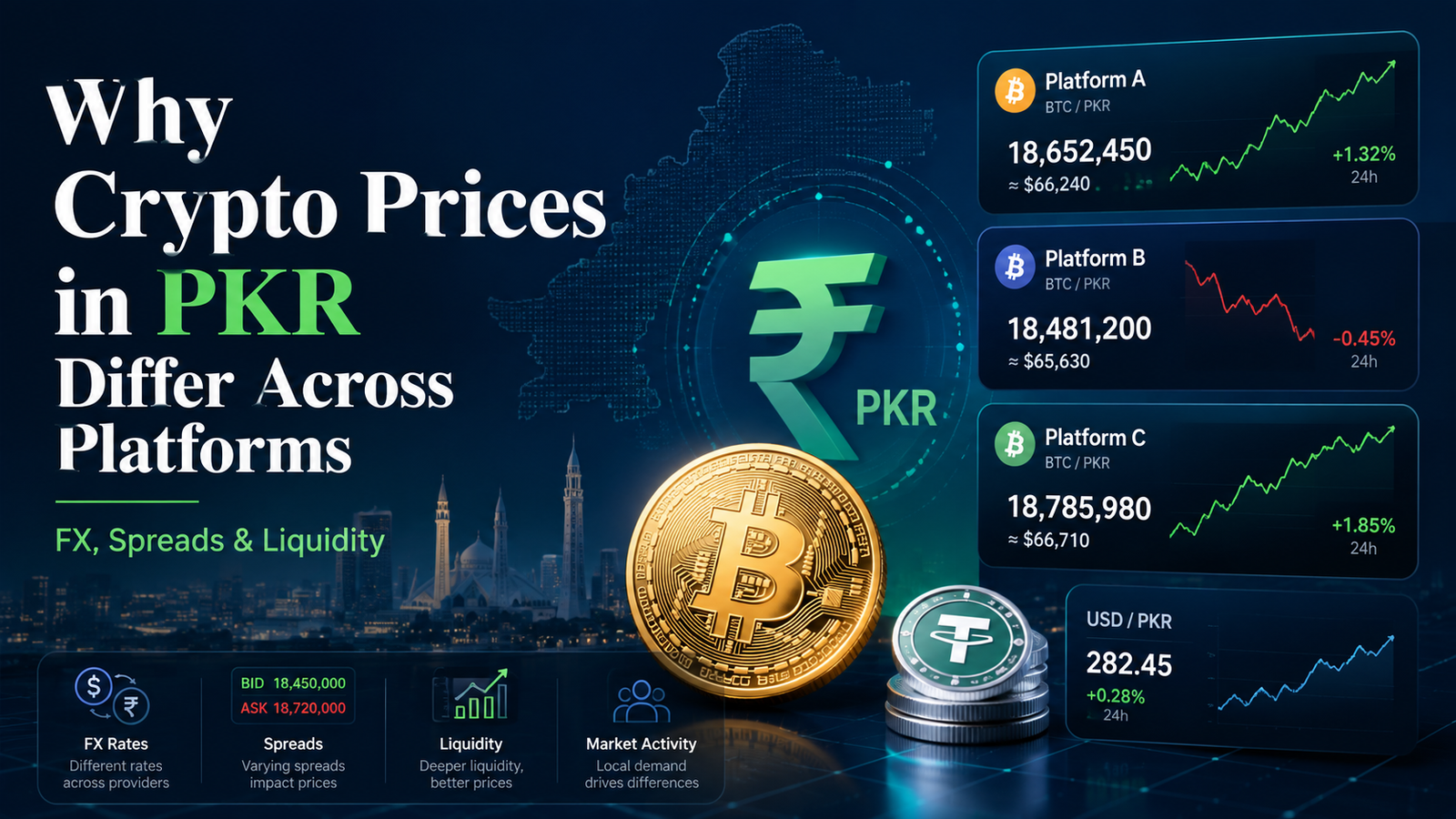
A crypto price in PKR is not one fixed number. It changes across exchanges, P2P markets, price trackers and instant-buy apps because each platform applies its own USD/PKR conversion rate, spread, fee structure and liquidity conditions. The lowest number on screen is not automatically the best deal, what matters is the effective price: total PKR spent divided by crypto actually received.
Key Takeaways
- Reference price, market price, and effective purchase price are three different things, only the last one tells you what you actually pay.
- The FX rate a platform uses to convert USD/USDT into PKR can differ from the State Bank of Pakistan’s benchmark rate.
- Spreads, trading fees, payment charges and slippage all sit on top of the “headline” price.
- Order size matters: a small purchase and a large one can fill at very different average prices on the same platform.
- Visible price gaps between platforms are not automatically arbitrage profit once costs and execution risk are counted.
Why Can the Same Crypto Price in PKR Differ Across Platforms?
Crypto markets are fragmented. Each venue discovers or calculates its own executable price, and converting that price into PKR adds a second, local layer of pricing on top.
Four factors drive most of the difference you see between platforms:
- FX rate used to convert USD or USDT into PKR
- Spread and markup built into the platform or payment method
- Liquidity and order-book depth, which affect how much a large order moves the price
- Trading route, spot market, P2P, or instant fiat purchase
A simple way to think about it:
Effective PKR price ≈ global crypto price × effective USD/PKR rate + spread + fees + slippage/payment costs
Global arbitrage keeps major crypto markets broadly aligned with each other, but it does not force every retail PKR quote in Pakistan to match exactly. Local supply, demand and payment friction still create real gaps.
How Does the USD/PKR Exchange Rate Affect Crypto Prices?
Most major cryptocurrencies, including Bitcoin and Ethereum, are priced against the US dollar or a dollar-linked stablecoin like USDT. To show a PKR price, a platform must either apply an FX conversion or source a PKR market rate directly. The same process applies when users convert BAT to PKR for valuation purposes: the displayed result depends not only on BAT’s underlying market price but also on the PKR conversion rate used by the platform.
The problem is that “the USD/PKR rate” isn’t a single figure. It can mean:
- An official or reference exchange rate
- A rate tied to a specific payment channel or provider
- A PKR/USDT rate set by P2P supply and demand, which can run above or below the official rate
As a benchmark, on August 12, 2026, the State Bank of Pakistan published a USD conversion rate of PKR 277.6429 for specified customer transactions. This is a useful reference point, but it is not necessarily the rate at which a retail buyer can actually acquire dollars or USDT, P2P and provider rates commonly diverge from it.
The impact compounds at higher values. Even a 1–2% difference in the effective FX rate translates into a meaningful PKR gap on a large Bitcoin purchase, simply because the base price is so high. Always check the source and timestamp of any FX figure rather than treating one number as “the” true rate.
Read more: How to buy Bitcoin (BTC) with US Dollars (USD)?
How Do Spreads, Fees and Markups Change What You Actually Pay?
The bid-ask spread is the gap between the best price a buyer will pay and the best price a seller will accept. A wider spread makes it more expensive to enter or exit a position immediately.
Beyond the spread, several separate costs often get lumped together and confused:
- Trading spread
- Explicit trading fee
- Fiat processing or card fee
- P2P merchant premium
- Deposit and withdrawal costs
A route advertised as “zero-fee” can still be more expensive overall if it embeds a wider spread or a less favorable FX rate. That’s why the metric worth comparing is the all-in effective price:
Total PKR spent ÷ crypto received
Compare the final confirmation screen or executable order, not the homepage price widget. Order-book terms like bids, asks and market depth are standard across centralized exchanges and are worth understanding before placing larger orders.
How Do Liquidity and Order-Book Depth Cause Different Prices?
Liquidity determines how much a real order moves the price. On a highly liquid market, many orders sit close to the current price, so spreads stay tight and large orders have limited price impact. On a thin market, fewer orders are available, so bigger orders “eat into” progressively worse prices, an effect known as slippage.
This plays out differently depending on the market:
- BTC/USDT or ETH/USDT on an active exchange typically has deep liquidity
- A small altcoin often has thinner order books
- A local P2P PKR market can be comparatively shallow, especially for larger amounts
A PKR 20,000 purchase will likely fill close to the displayed quote. A PKR 2 million purchase may execute at a noticeably worse average price if depth is limited. MEXC’s own market-order documentation, as one industry example, notes that larger market orders can consume available order-book liquidity and receive a worse average fill, illustrating a general liquidity risk rather than a platform-specific flaw.
Why Do P2P, Spot Markets and Instant-Buy Services Show Different Prices?
These are different products, not different views of the same market, so their displayed numbers shouldn’t be compared as if identical.
| Route | How price is formed | Main benefit | Main risk/cost |
| Spot market (e.g., BTC/USDT) | Exchange order book | Transparent depth; potentially tight spreads | Still needs a PKR→USDT route; slippage and fees apply |
| P2P in PKR | Individual merchant/buyer offers | Direct local-currency settlement, choice of offers | Merchant premiums, payment and counterparty risk |
| Instant/card/third-party buy | Provider quote including conversion economics | Convenience, simple onboarding | FX markup, processing fees, wider embedded spread |
| PKR price converter | Reference price × FX conversion | Fast valuation and comparison | May not be an executable trade |
Binance’s P2P marketplace, for example, allows advertisers to set fixed or floating prices, which helps explain why individual PKR offers vary even for the same coin at the same moment. MEXC similarly separates its reference conversion tool from actual spot-market execution, a distinction worth checking on any platform before trading.
Are Price Differences an Arbitrage Opportunity?
Sometimes, but a visible price gap is not the same as arbitrage profit. The real test is:
Net arbitrage = selling proceeds − purchase cost − trading fees − withdrawal/network fees − FX costs − slippage
Several execution constraints can erase an apparent gap before a trade completes:
- Deposit and withdrawal processing speed
- Blockchain confirmation time
- P2P transaction limits
- Order-book depth on both sides of the trade
- Stablecoin or fiat conversion costs
- Price movement while funds are in transit
On liquid markets, professional arbitrage activity itself tends to narrow persistent gaps over time. Genuine, temporary discrepancies can exist, but apparent premiums often shrink or disappear once all costs and execution risk are factored in. Treat arbitrage as a possibility to evaluate carefully, not a guaranteed source of income.
Decision Framework: How to Compare Crypto Prices in PKR Before Buying
Use this six-step process for any comparison:
- Match the exact asset and market. Don’t compare a BTC/USDT spot price with a BTC instant-buy quote without accounting for the conversion route.
- Use the same PKR amount across platforms, liquidity effects depend heavily on order size.
- Record quotes at roughly the same time, since crypto prices move continuously.
- Check the effective FX rate. Identify whether the platform uses a reference rate, a P2P-derived rate, or a third-party provider quote.
- Add every cost before comparing, spreads, trading and payment fees, withdrawal costs, and expected slippage.
- Calculate crypto received per PKR spent, and choose the venue with the best net execution, not the lowest headline number.
What else to check besides price
- Platform security and custody arrangements
- Withdrawal availability and limits
- P2P counterparty history and escrow protections
- Payment method reliability
- Current Pakistani regulatory status
On regulation: Pakistan has enacted the Virtual Assets Act, 2026, with the Pakistan Virtual Assets Regulatory Authority (PVARA) overseeing virtual asset service providers. As of this writing, PVARA’s detailed 2026 service regulations remained in draft form following a public consultation that closed on July 2, 2026. Because this framework is still developing, readers should verify the current regulatory status directly with PVARA or official sources before transacting, rather than relying on any single article.
FAQs About Crypto Prices in PKR
Why is the Bitcoin price in PKR on Google or a price tracker different from an exchange?
Trackers often show a reference conversion, a global crypto price multiplied by an FX rate, rather than the executable price actually available to a Pakistani buyer on a specific platform.
Why is USDT sometimes worth more or less than the USD/PKR conversion suggests?
Local USDT supply, demand and payment conditions in the P2P market can push USDT to trade at a premium or discount relative to a simple USD/PKR calculation.
Which platform has the cheapest crypto price in PKR?
No platform is consistently cheapest. Compare the effective, all-in price for the same coin, the same PKR amount and the same payment method before deciding.
Conclusion
The most useful crypto price in PKR is the executable, all-in price for the specific amount you intend to buy or sell, not the first number that loads on screen. Before choosing a venue, compare the crypto you’ll actually receive, the FX conversion applied, the transaction costs involved, and the liquidity available for your order size. That comparison, done consistently, matters far more than chasing the lowest headline quote.