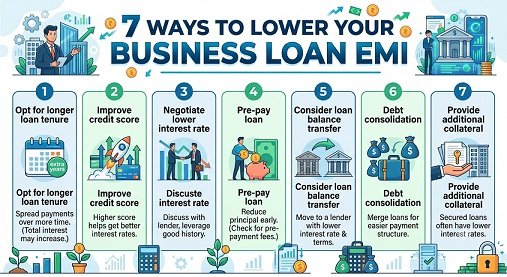
| Quick answer: You can lower a business loan EMI by choosing a longer tenure, making part-prepayments, transferring the loan to a cheaper lender, borrowing only what you need, improving your credit to earn a better rate, picking a flexible repayment structure, and negotiating fees. Some reduce the monthly outgo at the cost of more total interest, so weigh each trade-off. Here are the seven, and when each one helps. |
A high EMI strains cash flow, especially in a slow month, and many owners assume they are stuck with the figure they signed up for. In fact, there are several ways to bring it down, some before you borrow and some after. Keeping the EMI on a business loan comfortable is what keeps the loan a help rather than a monthly burden. Here are seven ways to lower it, with the trade-off each one carries.
Why the EMI is more flexible than it looks
An EMI is set by three things: the loan amount, the interest rate, and the tenure. Change any of them and the monthly figure moves. That means the EMI is not fixed by fate but shaped by choices you make, both when you take the loan and sometimes during it. The Reserve Bank of India requires lenders to disclose the EMI and the full cost clearly, so you can see exactly how these levers affect what you pay.
The key is to understand the trade-offs. Lowering the EMI by stretching the tenure, for instance, eases the monthly outgo but raises the total interest over the life of the loan. Lowering it by improving your rate or borrowing less reduces both. Development institutions such as SIDBI stress matching borrowing to what a business can comfortably service, and a manageable EMI is central to that, as the Ministry of MSME has noted for firms running on tight margins.
The seven levers below split into two groups: those you use before you borrow, by sizing the loan and rate well, and those you use after, by prepaying or switching. Knowing both means you can keep the EMI comfortable whether you are about to take a loan or already carrying one.
It helps to know which lever to reach for, because they are not interchangeable. Some, like a longer tenure or a better rate, are set when you take the loan, so they matter most before you sign. Others, like part-prepayment or a balance transfer, are available after you are already repaying, which means even a loan you regret is not beyond improvement. Knowing both sets means you are never stuck with an EMI that strains your cash flow, whether you are about to borrow or halfway through a loan already running.
Seven ways to lower your EMI
1. Choose a longer tenure
The simplest lever: a longer tenure spreads the loan over more instalments, so each EMI is smaller. The trade is more total interest, since you pay over a longer period. It suits a business that needs breathing room in the monthly figure, as long as you accept the higher overall cost.
2. Make part-prepayments
Paying a lump sum towards the principal when you have surplus reduces the outstanding balance, which can lower either the EMI or the remaining tenure. Check for any part-payment charges first, but used when cash allows, it is an effective way to cut both the monthly figure and the total interest you pay.
3. Transfer to a cheaper lender
If your rate is higher than what you could get now, a balance transfer moves the outstanding loan to a lender offering less, lowering the EMI. It works when the rate drop is meaningful and enough tenure remains to recover the switching cost. Compare the business loan interest rate on offer against your current one before you move.
4. Borrow only what you need
The surest way to a lower EMI is a smaller loan. Borrowing to a specific need rather than the maximum on offer keeps the principal, and therefore the EMI, down. Sizing the loan to what you can repay comfortably, with a small buffer, avoids a monthly figure larger than the business needs to carry.
5. Improve your credit for a better rate
A stronger credit profile earns a lower rate, which lowers the EMI for the same loan. Lifting your score, showing provable turnover, and clearing small debts before you apply can move you into a better rate band. The work you do on your profile shows up directly in a gentler monthly figure.
6. Pick a flexible repayment structure
Some lenders offer structures such as step-up or step-down EMIs, or seasonal repayment that flexes with your cash flow. A structure matched to how your business earns, lower when cash is tight and higher when it is strong, can ease the pressure of a flat EMI, especially for a seasonal business.
7. Negotiate the fees and terms
The EMI is not the only cost, and the overall burden can sometimes be eased by negotiating the processing fee or other charges, or by choosing a loan with fewer of them. Running the amount and tenure through a business loan EMI calculator, then adding the fees, shows the true monthly and total cost of each option.
Lever and trade-off at a glance
| Lever | Effect on EMI | Trade-off |
| Longer tenure | Lower EMI | More total interest |
| Part-prepayment | Lower EMI or tenure | Needs surplus cash |
| Balance transfer | Lower EMI | Switching cost to recover |
| Borrow less | Lower EMI | Smaller loan amount |
| Better rate | Lower EMI | Needs a stronger profile |
The effects are indicative; your exact EMI depends on the amount, rate, and tenure your lender offers.
The bottom line
The EMI is more flexible than it looks, shaped by the amount, rate, and tenure you choose. Before you borrow, size the loan well and earn a better rate; after you borrow, part-prepay or transfer to a cheaper lender. Just weigh the trade-offs, since a longer tenure eases the monthly figure but costs more interest overall. Aim for an EMI you can clear comfortably even in a slow month, with room to spare, and the loan stays a tool rather than a strain.
Frequently asked questions
How can I reduce my business loan EMI?
Choose a longer tenure, make part-prepayments, transfer the loan to a cheaper lender, borrow only what you need, or improve your credit to earn a better rate. Some lower the EMI at the cost of more total interest, so weigh each trade-off before deciding.
Does a longer tenure lower the EMI?
Yes. Spreading the loan over more instalments reduces each monthly payment, but you pay more total interest over the longer period. It suits a business that needs a lower monthly figure, as long as you accept the higher overall cost of the loan.
Can I lower my EMI on an existing loan?
Yes. Part-prepaying a lump sum reduces the balance and can lower the EMI, and a balance transfer to a lender offering a lower rate can reduce it too. Check for part-payment or foreclosure charges first, and make sure any saving beats the cost of switching.